
Successful change starts with people: experiences from the Change Management programme
“Successful change is ultimately about people and behaviour, not simply about changing structures, systems or procedures.” This was one of the key takeaways for Ms. Joanna Piscopo from Malta after participating in the five-day Short Executive Programme on Change Management, which took place from 21 – 25 September 2026 at the MSM-UM campus in Maastricht.
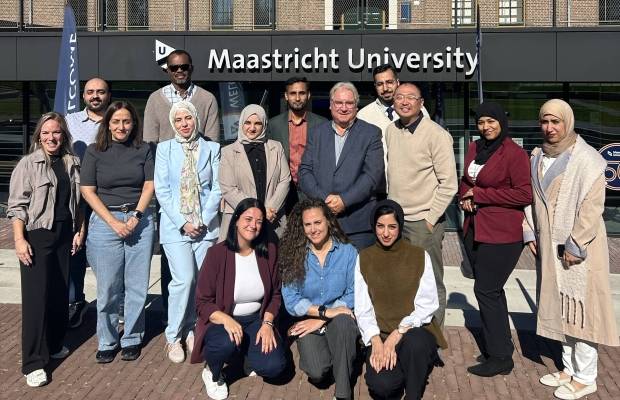
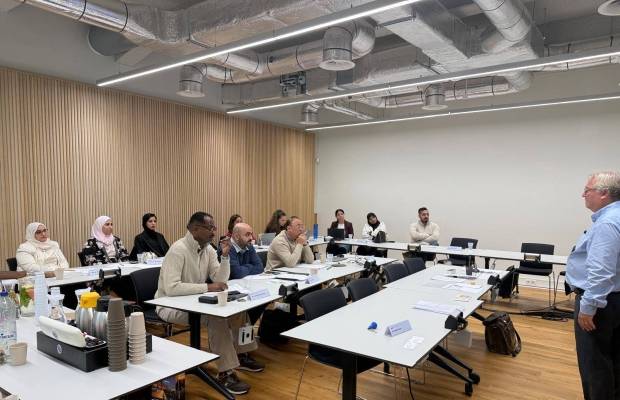
The programme brought together 14 professionals from eight different countries: Lebanon, Iraq, Oman, Malta, Nigeria, Saudi Arabia, Bangladesh and Indonesia. During an intensive week of learning and exchange, participants explored different perspectives on organisational change and reflected on how these could be applied within their own organisations.
Understanding change through theory and practice
For Ms. Gloria Abdo from Lebanon, the combination of theoretical insights, practical tools and interaction was an important part of the learning experience. “The Change Management programme was a highly enriching and engaging experience, combining strong theoretical foundations with a lot of practical tools, case discussions and opportunities to reflect on our own organizational realities. I particularly appreciated the interactive approach of the programme, which encouraged us not only to understand change, but also to think concretely about how to lead and implement it within our own institutions.”
Ms. Elissar Sabbah, also from Lebanon, experienced the programme as closely connected to the challenges she encounters in her professional environment. “I experienced the Change Management programme as a very enriching and inspiring experience. It gave me the opportunity to look at organizational change from different perspectives and to reflect on my own role as a leader in a changing organization. The programme was practical, interactive, and strongly connected to real-life challenges that I face in my work in the public sector.
For Ms. Piscopo, the programme also challenged some of her existing thinking about organisational change. “I found the programme extremely insightful, practical and relevant to my current role. It provided a good balance between theory, practical tools and real-life discussions, and challenged some of my existing thinking about how organisational change should be approached.”
Successful change is about people
Although the three participants work in different contexts, a common theme stands out from their experience: successfully managing change requires looking beyond structures, systems and processes and understanding the people involved.
“My main takeaway is that successful change is not simply about introducing new structures or processes; it is first and foremost about people, culture, trust and engagement,” Ms. Abdo explains. “Understanding the dynamics behind resistance, involving stakeholders and communicating the purpose of change clearly are essential if we want transformation to be sustainable rather than temporary.”
Ms. Sabbah came to a similar conclusion: “My key takeaway is that change is not only about changing systems and processes; it is about changing people’s mindset, behaviors, and ways of working.” She also emphasises that managing change requires an approach that takes the specific situation into account. “I particularly appreciated learning that there is no single approach to managing change. Different situations require different strategies, and understanding the people, culture, context, and type of change is essential. The different perspectives on change helped me better understand resistance and how to engage people throughout the change process.”
For Ms. Piscopo, understanding the people involved in change was equally important. “People do not necessarily resist change itself; they resist feeling that change is being imposed on them. Effective change therefore requires listening, understanding different perspectives, building trust and creating genuine buy-in.
From learning to the workplace
The programme also provided participants with insights and tools they can take back to their own organisations. For Ms. Sabbah, the lessons learned have a direct connection to her work at the Ministry of Economy and Trade.
“This is especially relevant to my work at the Ministry of Economy and Trade, where we are working on digital transformation, AI, and the modernization of public services. I learned that successful transformation requires not only technology, but also communication, trust, participation, and strong leadership.”
Ms. Piscopo particularly valued the emphasis on understanding an organisation before deciding how to approach change. “I particularly appreciated the emphasis on understanding the organisation and its people before deciding how to implement change, rather than applying a standard approach to every situation. I came away feeling better equipped to manage change assignments in my own organisation and to immediately apply some of the tools and techniques learned.”
Learning in a multicultural environment
With 14 participants representing eight countries, learning did not only take place through the programme content. The different professional, organisational and cultural perspectives within the group also contributed to the experience. “The multicultural dimension was one of the most valuable aspects of the experience,” says Ms. Abdo. “Learning alongside participants from different countries, professional backgrounds and organizational contexts created very rich exchanges and demonstrated that, while our environments may differ, many of the challenges related to leadership and organizational change are shared. It also encouraged me to look at familiar situations from new perspectives, which is one of the greatest benefits of international executive education.”
Ms. Sabbah also highlights the value of exchanging experiences across countries and professional backgrounds. “Being part of a multicultural learning environment was one of the most valuable aspects of the programme. Sharing experiences with participants from different countries and professional backgrounds showed me that organizations may have different cultures and structures, but many of the challenges related to change are universal.”
She adds:“The discussions allowed me to learn from different approaches and to reflect on my own way of dealing with change. It also reminded me that diversity of perspectives can be a powerful resource when managing transformation.”
Ms. Piscopo recognised a similar commonality among the participants despite their different backgrounds: “I very much enjoyed the different experiences shared. Although the participants represented different countries, certain problems faced are very much similar.”
About the Change Management programme
The Short Executive Programme on Change Management provides professionals with theoretical perspectives and practical tools to better understand, lead and implement organisational change. Through an interactive learning approach, participants are encouraged to connect these insights to the change challenges within their own organisations.
Would you like to join the Change Management programme as well?
The next programme will take place from 24 – 28 May 2027. Click here for more information about the programme and how to apply.
Related news
Leading Strategy in Practice: A dynamic learning experience in Maastricht
Exploring Strategic Collaboration with Ngorongoro Conservation Area