
Leading high performance in banking: Insights from the PIM Sri Lanka custom made programme
As digital technologies, artificial intelligence, and new financial innovations reshape the global banking sector, leadership in financial institutions is evolving rapidly. But what does effective performance leadership look like in this new environment, and how can banking executives translate strategic frameworks into practical organisational change?
At Maastricht School of Management (MSM), part of Maastricht University, executive education programmes aim to bridge this gap between theory and practice. A recent example is the custom-made “Driving High Performance: Strategic Leadership for Banking Executives” programme, which was delivered for participants from the Postgraduate Institute of Management (PIM) Sri Lanka in May 2025.
The five-day programme brought together senior banking professionals for an intensive learning experience combining expert-led sessions, real-world case discussions, and networking opportunities, empowering banking leaders to drive meaningful performance in a rapidly changing financial landscape.
A central theme of the programme was strategic performance management. Participants explored key frameworks such as the Balanced Scorecard and the Performance Prism, reflected on leadership impact using tools like the OCLG+P model and applied these insights to real case studies from the banking sector.
Another key focus was building higher-performing teams. Strategy alone does not guarantee success and deliver results; successful execution depends on effective teamwork and leadership. The programme explored a central question for banking executives: what does effective performance leadership look like, and how can strategic concepts be adapted into real organisational practice? Through interactive sessions and leadership frameworks, participants reflected on how performance is defined within their institutions, how it aligns with broader business goals, and how leaders can motivate teams to navigate these challenges of managing high-performance organisations.
A distinctive feature of the programme was the integration of institutional visits across Europe, offering participants the opportunity to see how innovation and leadership strategies are implemented in practice.
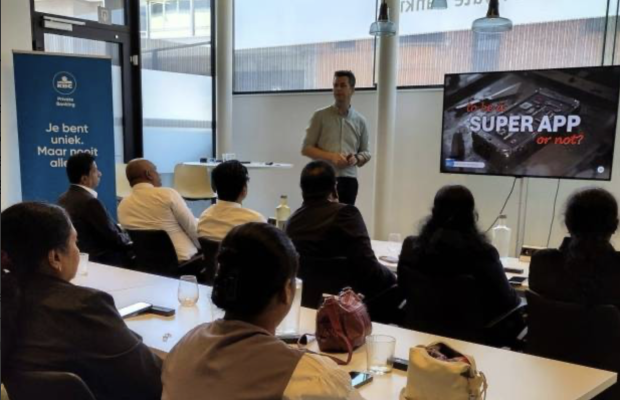
At KBC Group, discussions explored how artificial intelligence is transforming customer experiences and empowering banking careers. Seeing as the banking industry is at the brink of its next defining moment, transitions from branches to apps and from transactional convenience to digital personalisation. This session was dedicated to exploring the rise of Agentic AI, not as a tool, but rather as a transformative force poised to reshape how banks operate.
At the European Investment Bank (EIB), participants gained insights on how financial institutions support projects that drive sustainable economic growth, innovation, and large-scale development initiatives.
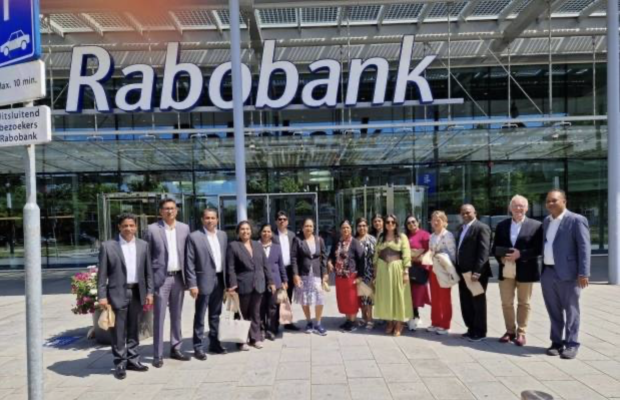
The visit to Rabobank, a prominent Dutch multinational bank, highlighted the bank’s cooperative structure and its commitment to sustainability, digital innovation, and financial inclusion. Discussions varied from payment innovations and the digital euro to the role of digital technologies in supporting agricultural finance and global food systems.
Finally, at Tech Mahindra, the session outlined current market trends that are impacting European banks and participants explored how technologies such as artificial intelligence, machine learning, and blockchain are transforming the banking and financial services sector.
Together, these opportunities provided valuable opportunities for learning, benchmarking, and dialogue with industry experts. By combining academic insights with real-world examples, the programme encouraged participants to reflect on how leadership, strategy, and innovation interact within modern financial institutions.
As the financial sector continues to evolve, such programmes highlight the importance of leadership development in navigating technological change and strengthening institutional performance. Through its custom-made training programmes, MSM continues to support organisations and professionals worldwide in building the leadership capabilities needed to thrive in an increasingly complex global economy.
Related news: