
Embedding sustainability and inclusivity through the IIM Lucknow Immersion Programme
Sustainability and inclusivity are often presented as strategic ambitions, but how are they translated into institutional practice?
At Maastricht School of Management’s Expert Centre on Emerging Economies (ECEE), we work with institutions to translate sustainability ambitions into practical governance, policy, and business solutions. Our factsheet “Approach to sustainability, inclusivity and competitiveness of institutions for private sector development” outlines how strengthening the institutional capacity of organisations is key to fostering a competitive, inclusive, and sustainable business environment.
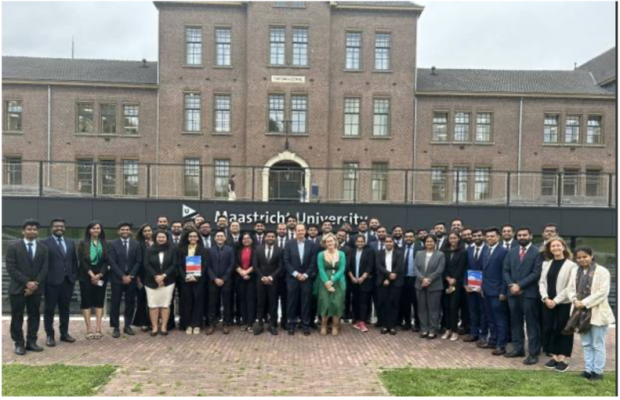
An example of this approach is the Custom-Made Training Programme for the Indian Institute of Management Lucknow (IIM Lucknow), delivered in September 2024.
The tailored two-week programme was designed around the theme of Sustainable Management, combining academic input, active workshops, field trips, and company visits. It integrated the topic of sustainability across diverse subjects such as:
- Corporate social responsibility and ethical business strategy
- Climate resilience and governance of local governance
- Circular economy models and sustainable value chains
- Partnerships for climate resilient economic development
- Sustainable finance and investments
- AI-powered innovation: Design thinking for new products and services
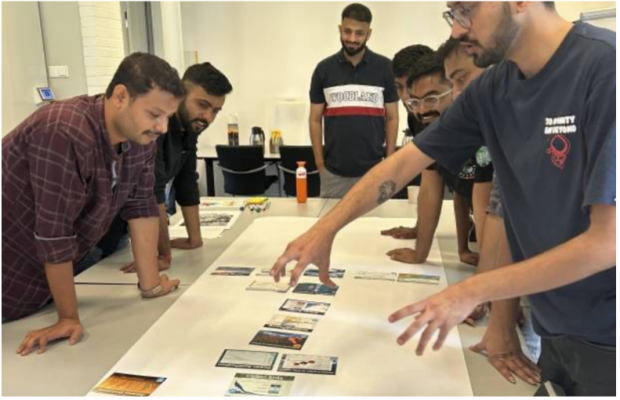
Different activities, such as the Climate Fresk Workshop, the DNA Sustainability Game, the Ceuvel Tour, and work visits to the Gulpener Brewery, the European Parliament forum, and Sustainable Amsterdam, deepened the understanding of the transition of sustainability from theory into practice.
- Sustainability-oriented adivsory services
Through modules on CSR, green growth, circular economy, and climate-resilient development, participants gained the skills necessary to familiarize themselves with how organisations incorporate social and environmental responsibility into their operations and strategy. - Inclusive development & business advisory
Diverse discussions on local governments, partnerships, smart cities, and the European Parliament highlighted the role of institutions in fostering inclusive economic systems and a circular economy. - Enhancing institutional competitiveness
Workshops such as AI-powered Innovation and sustainable finance and investments sessions illustrated how sustainability and digital transformation can strengthen long-term resilience and institutional competitiveness.
The IIM Lucknow immersion programme demonstrates how institutional capacity building can move beyond knowledge and theory into more practical and concrete action plans. It highlights how the government, knowledge institutions, and the private sector should come together to collaborate effectively and efficiently in order to deliver on climate change and build resilience to create impact.
In addition to that, the programme fostered cross-cultural dialogue and peer learning to equip participants with the essential tools and methodologies to foster innovation in their own way through a user-centred lens.
As sustainability increasingly shapes global markets, regulatory environments, and investment decisions, management education must evolve to keep pace. The IIM Lucknow Immersion Programme has proven to be an enriching experience, catering to the students with diverse topics and skills such as corporate social responsibility, sustainable urban development, smart cities, sustainable finance and investments, and AI design thinking.
MSM’s global Custom-Made programmes are developed to help shape or transform your organisation and to develop your people. Tailored to the specific training needs and objectives of your organisation, the custom-made programmes are the perfect tool to strengthen the leadership skills and expertise of your professionals. For more info, please contact Michela Parrillo , Manager, Executive Education and Custom Made Training.
More blogs