
 Leading in a Rapidly Changing World
Course objectives
By the end of the programme, participants will be able to:
- Build and communicate a strategic resilience framework
- Identify organisational vulnerabilities and emerging external risks
- Apply strategic foresight and scenario planning tools
- Analyse geopolitical, technological, climate, cyber, and workforce-related disruptions
- Strengthen operational and crisis management capabilities
- Lead organisations and teams effectively during uncertainty
- Develop sector-specific future scenarios and response strategies
- Translate resilience insights into concrete organisational action plans
- Develop a practical 90-day resilience roadmap
Topics
Strategic resilience in a disrupted world
- The new era of uncertainty and systemic disruption
- Global megatrends reshaping business and government
- Geopolitical instability
- AI and technological disruption
- Climate and energy transition
- Supply chain vulnerabilities
- Demographic and workforce shifts - Emerging global risks and their organisational impact
- Why resilience is now a boardroom issue
- The resilience maturity model
- Systems thinking and interconnected risk
Leadership, culture and crisis management
- Crisis leadership under pressure
- Executive decision-making during uncertainty
- Crisis communication and stakeholder trust
- Building adaptive and resilient cultures
- Psychological safety and workforce resilience
- Managing multicultural and distributed teams
- Inclusion as a resilience capability
- Leadership during transformation and instability
- Workforce disruption and talent retention
- AI-driven workforce change
- Crisis management structures and governance
- Developing and testing crisis management plans
- Best practices for crisis preparedness and response
Operational risk and organisational continuity
- Operational risk management frameworks
- Enterprise risk and continuity architecture
- Critical operations and infrastructure protection
- Supply chain resilience and logistics disruption
- Business continuity planning
- Crisis escalation and response structures
- Risk monitoring and early warning systems
- External operational risks
- Governance, accountability, and response coordination
Strategic foresight and scenario planning
- Introduction to strategic foresight
- Foresight as a leadership capability
- Signals, trends, drivers, and weak signals
- The horizons framework
- Causal layered analysis
- DEFT analysis: Drivers, Enablers, Frictions, Turners
- Workforce transformation and future talent challenges
- Scenario planning methodologies
- Futures wheel and trend impact analysis
- Translating foresight into strategic decision-making
From insight to action: building the resilience roadmap
- Integrating resilience into business strategy
- Governance and board-level discussions
- Strategic investment priorities under uncertainty
- Measuring organisational preparedness and performance
- KPIs and performance indicators
- Communicating resilience internally
- Identifying organisational blind spots
- Building adaptive leadership capability
- Translating scenarios into action plans
- Developing the 90-day resilience roadmap
Teaching Methods
- Interactive lectures and executive discussions
- Real-world case studies
- Crisis management simulations
- Scenario planning and foresight workshops
- Group exercises and peer learning
- Organisational resilience assessments
- Action planning and resilience roadmap development
- Participant presentations and feedback sessions
Your profile
This programme is designed for senior leaders, executives, directors, and decision-makers responsible for organisational performance, risk, resilience, continuity, and transformation in both the public and private sectors.This programme is for you if you:
- Lead teams, business units, or organisations operating in complex and rapidly changing environments.
- Want to strengthen your ability to anticipate, prepare for, and respond to disruption and crises.
- Are responsible for organisational resilience, risk management, business continuity, or strategic planning.
- Seek practical tools to navigate geopolitical, technological, workforce, cyber, and operational challenges.
- Want to develop strategic foresight and scenario planning capabilities to prepare your organisation for future uncertainties.
- Need to make critical decisions under pressure while maintaining stakeholder confidence and operational stability.
- Are leading transformation initiatives and want to build a more adaptive and resilient organisation.
- Wish to exchange experiences and best practices with a diverse group of senior professionals and executives.
Certificate
Each participant receives a certificate of participation.
This certificate is being awarded as evidence of participation in a post-graduate training at indicative level 6 of the EQF. The minimum study load is 14 hours and an attendance level of 80% is required. This certificate is being awarded in the form of a soft copy when the training is online or a hard copy during a face-to-face training. The certificate will mention your full name, training title, training date and comprising core topics. Click here for more information about the MSM certification policy.
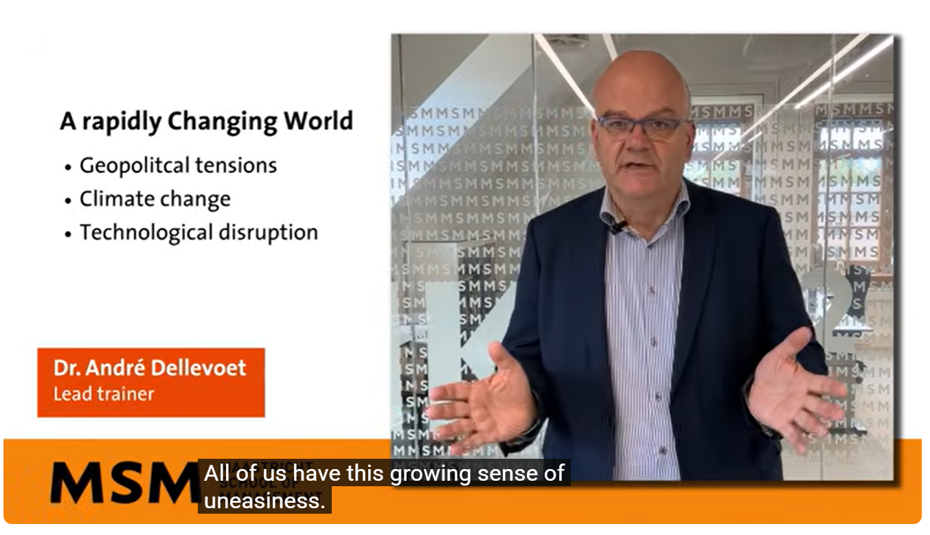
Have a look at the video in which Dr. Andre Dellevoet explains more about the importance of the programme and why you should join.