

 Applied Research Methods
The Applied Research Methods course helps participants in the preparation of a research proposal. Divided over four modules, a series of short instructive videos explain the key elements of a research proposal and the basics of research methodology. Short instructive videos, course literature, individual assignments, virtual classes, group chat opportunities and individual feedback from the lecturer will prepare participants for the completion of the research proposal.
Module 1: Foundations of research proposal design
This module introduces participants into the world of academic research. The focus is on the various stages of the empirical research cycle, highlighting the prominent role theory plays in guiding research. The module helps you to formulate your research question and conceptualize your research interest by drawing on the relevant academic literature.
At the end of this module, you will be able to:
- Identify a research topic which is empirically feasible and theoretically defensible
- Draft a solid literature review to conceptualize the research topic
- Formulate a clear research question(s)
- Design a research strategy to address the research questions
- Understand what constitutes good research allowing a critical assessment of scholarly work
Module 2: Qualitative research: data collection and analysis
This module introduces you to the characteristics of and approaches to designing and conducting qualitative research projects. A series of short videos explain the key elements of a selection of qualitative research methods. Each video will make references to documents for further self study. Participants will work individually on an assignment comprising the design of qualitative research, which will be discussed in the virtual class.
At the end of this module, you will:
- Be familiar with the characteristics and logic of various qualitative research methods
- Know the strengths and weaknesses of these methods
- Operationalize your conceptual model into items to be used in interview questionnaires
- Be able to design a basic qualitative research study
- Understand how to prepare quantitative data for analysis
- Understand which methods can be used to analyse qualitative data
- Have basic knowledge of the value of (software) tools for qualitative data analysis
- Assess issues relating to reliability and validity of empirical findings
Module 3: Quantitative research: data collection
This module aims to provide you with a brief introduction to the survey as a data collection method. In quantitative research approaches, students may want to collect new data among specific populations that fit their research question. Alternatively, students may be professionally employed in organisations and might wish to collect data that will help address a specific organisational issue/concern, e.g., doing market research to understand the perceptions that both potential and actual customers have regarding a recently launched product. This module explains the route ahead for the survey as well as the main challenges in data collection and data preparation.
There is a video clip that is dedicated to each section of the module. In aggregate, the video clips explain the strengths and challenges of survey research, the different data types and how these can be operationalised and measured, the data collection procedure for a given target population, making a choice from a range of available sampling techniques, preparing the data obtained for further analysis and assessing the reliability and validity of the data obtained.
At the end of this module, you will be able to:
- Know the strengths and weaknesses of survey research
- Operationalize your conceptual model into items with the help of a data-table
- Sample respondents
- Choose from an available range of sampling techniques
- Understand the different methods that can be used to collect the survey data (e.g. face-to-face, telephone, web-based)
- Understand how to prepare quantitative data for analysis
- Assess issues relating to reliability and validity of empirical findings
Module 4: Quantitative research: data analysis
This module introduces students to the core logic and methods of quantitative data analysis in applied research. It focuses on how to move from a research question and conceptual model to an empirical model that can be tested using quantitative data. Rather than treating statistics as a purely technical exercise, the module explains how analytical choices should follow from the research question, the type of data available, the measurement of variables, and the hypotheses being tested.
The module covers common analytical approaches used in quantitative research, including descriptive statistics, correlation analysis, regression-based analysis, and the interpretation of empirical results. Attention is also given to measurement quality, model specification, reliability and validity, and the presentation of quantitative findings in a clear and academically rigorous way. The module is relevant for students working with survey data as well as those using existing datasets, organisational records, market data, or other forms of structured empirical data.
At the end of this module, you will be able to:
- Understand the relationship between research questions, conceptual models, variables, hypotheses, and empirical models
- Distinguish between conceptual and empirical models in quantitative research
- Understand key issues in measurement, variable construction, and data quality
- Assess reliability and validity issues in quantitative empirical research
- Understand the role of descriptive statistics and correlation analysis
- Select appropriate statistical methods for testing research hypotheses
- Understand regression-based analysis as a core framework for quantitative research
- Apply basic analytical logic to direct effects, mediation, moderation, and group comparisons where relevant
- Understand the importance of model specification and robustness checks
- Interpret statistical findings in a theoretically meaningful way
- Present quantitative results clearly in tables, figures, and written analysis
- Link empirical findings back to the research question, theoretical framework, and overall academic argument
Module 5: The research proposal
After the completion of the four modules, you have until 10 February 2027 to submit your research proposal. During this time, you will apply the knowledge gained in the earlier modules in the writing of your research proposal. You’ll also benefit from dedicated, built-in time for personalised one-on-one coaching, ensuring you get the guidance and support you need to succeed.
Teaching methods
- Instructive videos by the lecturer
- Course literature
- Individual assignments
- Individual feedback
- Group chat opportunities
- Virtual (feedback) classes
The online environment was professionally organised and easy to navigate. The tutors and supporting staff were consistently approachable and responsive, creating a supportive learning atmosphere. In addition, the interaction with peers provided useful exposure to different research contexts and perspectives.
Mr. Will Jacobs - participant Applied Research Methods 2026
Study hours
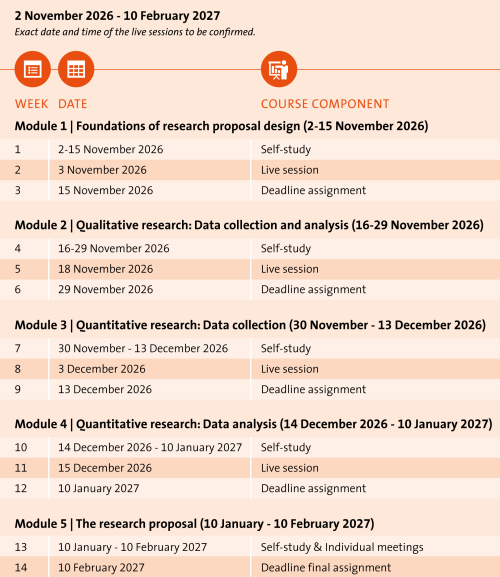
Module 1: 2 weeks (20 hours self study and 1 live session)
Module 2: 2 weeks (20 hours self study and 1 live session)
Module 3: 2 weeks (20 hours self study and 1 live session)
Module 4: 2 weeks (20 hours self study and 1 live session)
Module 5: writing of your research proposal (self study and live session(s))
Completion of the Research Proposal: Submission deadline 10 February 2027.
Upon completion of the modules individual coaching sessions will take place to guide you in the completion of your research proposal.
Live sessions
The main purpose of the live sessions is to provide the participants with the necessary theory and feedback in order to support you to submit the final assignment of each module, and in the end your research proposal.
Assignments
The modules include one or more assignments. These assignments will attribute to completing the research proposal. In addition, you will receive feedback on the assignments during the live sessions. The course will be completed with the successful completion of the research proposal. The completion of the assignments and a pass-level grade of the research proposal is necessary in order to obtain the certificate.
*A positive assessment of the final assignment of the course (the Research Proposal) will not guarantee admission to any PhD programme, including the PhD programme of MSM. Decisions to a PhD programme are with the respective PhD Admission Committee.
**If you would like to apply for the MSM Executive PhD programme after the Applied Research Methods programme, please take the MSM Research Themes into consideration. Click here for more information about the Research focus of the MSM Executive PhD in Private Sector Development.
Certificate
Each participant receives a certificate of participation.
This certificate is being awarded as evidence of participation in a post-graduate training at indicative level 7 of the EQF. The minimum study load is 14 hours and an attendance level of 80% is required. This certificate is being awarded in the form of a soft copy when the training is online or a hard copy during a face-to-face training. The certificate will mention your full name, training title, training date and comprising core topics. Click here for more information about the MSM certification policy.