
Ethiopian universities prepare for sustainability assessments through co-creation training in Addis Ababa
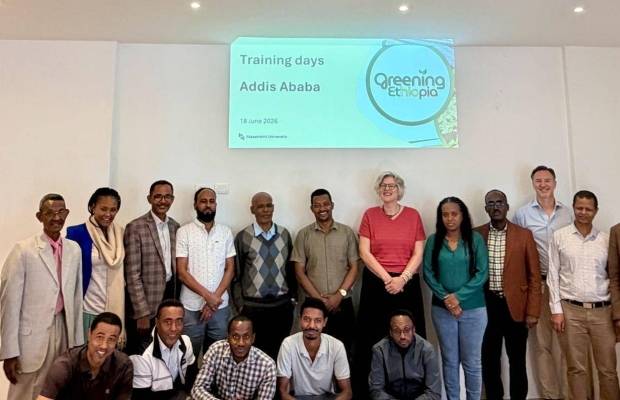
From 16 to 18 June 2026, representatives from four Ethiopian universities and Ethiopia’s Ministry of Education gathered in Addis Ababa for a three-day Sustainability Assessment Training under the Erasmus+ Capacity Building in Higher Education project Greening Ethiopia – Towards a more climate responsive higher Education system in support of sustainable agriculture and energy in Ethiopia.
The training marked an important milestone in the project’s efforts to strengthen the role of higher education institutions in supporting sustainable development and climate resilience in Ethiopia. Led by the Maastricht Sustainability Institute (MSI) and the Maastricht University Sustainability Office, the workshop focused on finalising a sustainability assessment framework that will be used by participating universities to evaluate and improve their sustainability performance.
Building a framework for sustainable transformation
The Greening Ethiopia project aims to strengthen the capacity of Ethiopian universities to contribute to sustainable agriculture, renewable energy, and climate-responsive development. As part of this effort, a sustainability assessment framework is being developed to help universities assess their current practices and identify opportunities for improvement. The assessment results will inform policy development, research activities, curriculum modernisation, and public-private partnership initiatives within the project.
The framework was developed by sustainability experts Dr. Annemarie van Zeijl-Rozema, Director of MSI and Jeroen Warnier, Director of the Maastricht University Sustainability Office. The framework was subsequently refined through a series of online consultations and co-creation sessions with Assosa University, Bahir Dar University, Haramaya University, Mekelle University, and the Ministry of Education. This process ensured that the framework reflects both international good practices and the institutional realities of Ethiopian higher education.
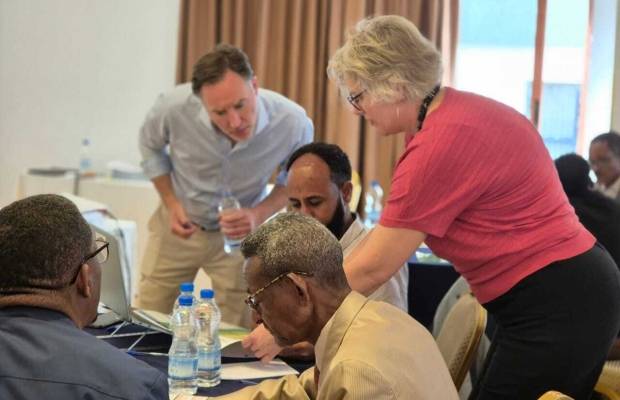
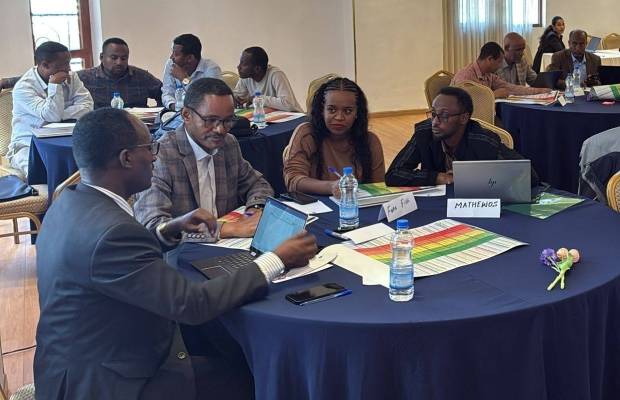
Building on this collaborative process, representatives of the all partners involved came together in Addis Ababa for a face-to-face training. The workshop focused on validating the framework, refining assessment rubrics and indicators, identifying data requirements and sources, and discussing practical approaches for data collection and analysis. Through a combination of group discussions, peer learning, and hands-on exercises, participants gained experience in applying the framework and developed institution-specific plans for conducting their first sustainability assessment.
A key outcome of the workshop was the joint validation of the framework’s rubrics and units of measurement, as well as the co-creation of a user guide to support the assessment process. Participants also assessed governance, leadership, and management practices within their own institutions, allowing them to test the framework in practice and exchange experiences with peers from other universities.
The coming months will focus on implementing the sustainability assessments across the participating universities. With continued support from Maastricht University, the partner institutions will collect and analyse sustainability data and prepare university-specific assessment reports. The findings will provide a valuable evidence base for the next phase of the Greening Ethiopia project, informing activities related to policy development, curriculum modernisation, research, and innovation aimed at strengthening climate-responsive higher education in Ethiopia.
Collaborative effort within Maastricht University
The Greening Ethiopia project is led by Maastricht School of Management (MSM), part of Maastricht University. In close collaboration with the Maastricht Sustainability Institute and the Maastricht University Sustainability Office, MSM has supported the development of the sustainability assessment framework and coordinated the organisation of the associated capacity-building activities. This collaborative approach has enabled the project partners to combine international expertise with local knowledge, laying the groundwork for meaningful and lasting sustainability improvements across the participating Ethiopian universities.
This publication was produced with the financial support of the European Union. Views and opinions expressed are however those of the author(s) only and do not necessarily reflect those of the European Union or the European Education and Culture Executive Agency (EACEA). Neither the European Union nor EACEA can be held responsible for them.

MSM's Expert Centre on Emerging Economies
This institutional collaboration project is part of MSM's Expert Centre on Emerging Economies. The department is an expert centre on sustainable private sector development in emerging and developing markets. We capacitate managers and professionals from government, private sector, NGOs, and post-secondary education in Africa, Asia, Middle East, and Latin America. We offer consultancy and customized training programs, and we manage complex projects in key sectors, e.g. water, agriculture and health. For more information, click here
Related news
Official kick-off of Greening Ethiopia project held in Addis Ababa
New project: Greening Ethiopia – Towards a more climate responsive higher education system in support of sustainable agriculture and energy in Ethiopia